Hej
Här är en mycket bra artikel om studieresultaten och den påvisar inte oväntat att det är dom regioner med Thailändska som andraspråk som presterar sämst i undersökningen ex.vis Isaan där modersmålet är Lao och södra Thailand där modersmålet är Malaj.
http://prachatai.org/english/node/6766?utm_source=feedburner&utm_medium=feed&utm_campaign=Feed%3A+prachataienglish+(Prachatai+in+English)
But first, the data. In 2011, Thailand recognized 62 ethnic communities as part of its Country Report to the Committee Responsible for the International Convention for the Elimination of All Forms of Racial Discrimination. Population estimates are possible due to the Country Report’s main reliance on Mahidol University’s ‘Ethnolinguistic Maps of Thailand Project’ data. From this data, a map of Thailand’s provinces by majority ethnicity (meaning >50%) can be created.
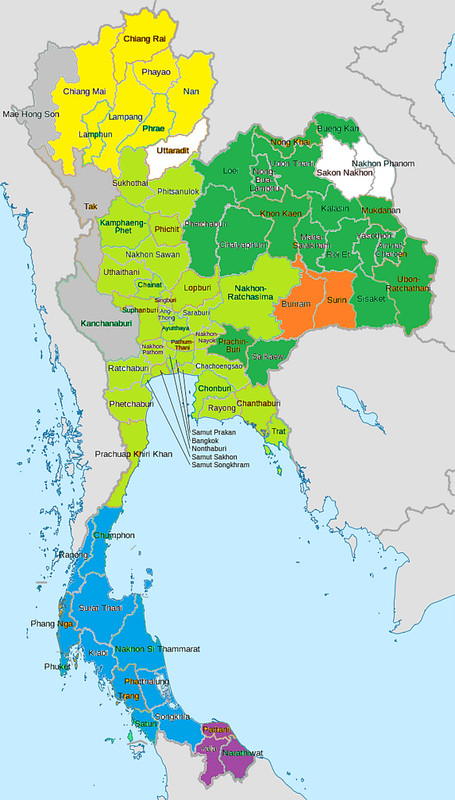
Key (Descending order of size): Light Green = Central Thai, Dark Green = Thai Lao, Yellow = Khon Muang (Northern Thai), Blue = Southern Thai, Orange = Thai Khmer, Purple = Thai Malay, Grey = Upland Minorities, White = Too Mixed to Classify (Sakhon Nakorn and Nakhon Phanom would be Thai Lao if Phu Thai counted as Lao)
This allows us to look at Thai Language Subject results by ethnicity in Thailand, using 2013 data:
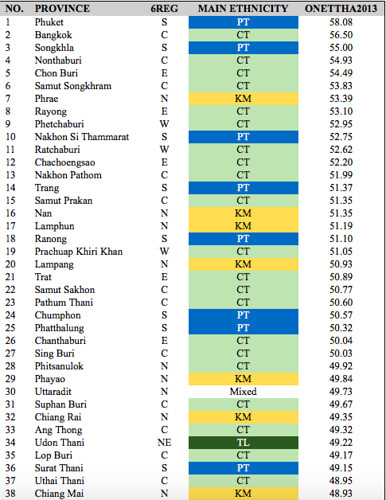
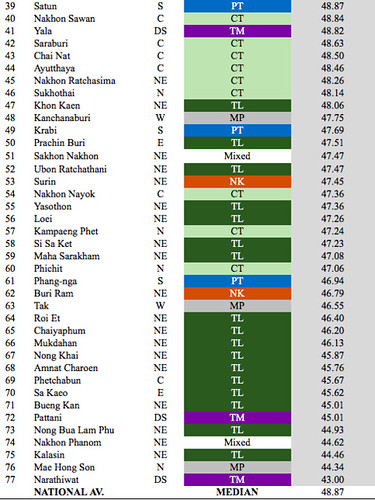
Here are the key findings:
100% of Khon Muang provinces are above the median (median score = 50.93)
72.7% of Southern Thai provinces are above the median (median score = 50.57)
70.0% of Central Thai provinces are above the median (median score = 50.04)
5.6% of Thai Lao provinces are above the median (median score = 46.30)
0.0% of Northern Khmer provinces are above the median (median score = 47.12)
0.0% of Uplands Minorities provinces are above the median (median score = 46.55)
0.0% of Thai Malay provinces are above the median (median score = 45.01)
As can be seen, the children of the majority of Thailand’s ethnic minorities score low, with the majority below the median, except in the North. One term for the associated phenomenon, following Dell Hymes, one of the first sociologists, is ‘linguistic deprivation’:
Children may be linguistically deprived if the language of their natural competence is not that of the school; if the contexts that elicit or permit use of that competence are absent in the school; if the purposes to which they put language and the ways in which they do so are absent or prohibited in the school.
This has been recognized as a problem for the Thai Lao of Northeast Thailand, the most numerous low-scoring ethnic minority, ever since the Thai school system was introduced as a replacement for the traditional Lao temple-based education system in the 1900s and formalized in the 1921 Primary Education Act.
Unfortunately, linguistic deprivation results in stereotyping by the majority culture. One Siamese official in the 1900s noted, “The populace of [Isan] circle are uncivilised and stupid. They have not yet attained the ability to behave according to the established customs and practices of the inner towns.” A 1914 gendarmerie tour inspection came to a similar conclusion: “They could only give rough answers, because the people of this circle are stupid and do not speak [Thai] lucidly.” Similarly, a Ministry of the Interior’s deputy’s tour in 1926 noted, “In those [Lao] towns the populace live in impoverished conditions, and they appear to be blithering idi*ts as well. Their level of education is still lower than our own.”
In the 1960s, after 40 years of mandatory primary education, in the Northeast “more than 59 percent of those who left school (or never attended it) cannot comprehend the simplest material at the grade 1 level”, with many of those who graduated Grade 4 within the previous 5 years even failing the Grade 1 test. The present 97-98% Thai literacy rate is based on graduating Grade 4 and would likely be much lower, especially for ethnic minorities, if actually tested. This may be why it is never tested.
Unfortunately, a lack of academic success in Thai and in all subjects taught in Thai may be misconstrued as a wider ‘cultural deprivation’ or ‘deficit’. This is systematic stereotyping of entire classes or minorities as being uneducable, having a diminished capacity for abstract thought, some form of cultural dissonance, or a form of inferiority compared to the mainstream culture, as is evident in the above quotes. Culturally deprived people may be characterized as demonstrating
-
Language deficiencies;
-
Perceptual deficiencies;
-
A mode of expression more rational and concrete than idea-systems-focused;
-
An orientation of life that seeks immediate gratification in the here-and-now rather than delaying for future advantage;
-
A poor self-image;
-
Aspirations too modest for academic success;
-
Apathy and detachment from formal goals and processes;
-
Limited role-behaviour skills and inadequate or inappropriate adult models.
Prince Siphichai’s 1926 inspection tour is a classic example of this viewpoint of the Thai Lao population, as when the report stated, “a rather large number of them are ethnically Lao, who are still lacking in civilisation, and are unambitious and narrow-minded.”
This kind of systematic stereotyping of ethnic minorities because the state education system ignores their needs is morally abhorrent. As dynamic assessment indicates, development should be tailored to individuals’ actual learning and potential learning, and individual attributes include mother tongue. While the state should of course teach the national language, not employing the mother tongue is wasting a resource, especially in the case of transboundary languages, i.e., Karen, Northern Khmer, Thai Lao, and Thai Malay. In the case of the Thai Malays, a bilingual approach starting with Thai Malay and bridging to dual language should be used – and tested on in the O-Net. In the case of the Thai Malay, the use of Thai Lao should be encouraged in the early years, again depending on the language patterns of the community (with differences between the rural and urban to be expected), and Thai Lao should be a subject language, tested on tailored versions of the O-Net Thai Language Subject and ultimately tested as a separate language on the O-Net – as should all the major languages of Thailand.
Mvh isan lover


 Själv är jag både oskolad och har tummen mitt i handen
