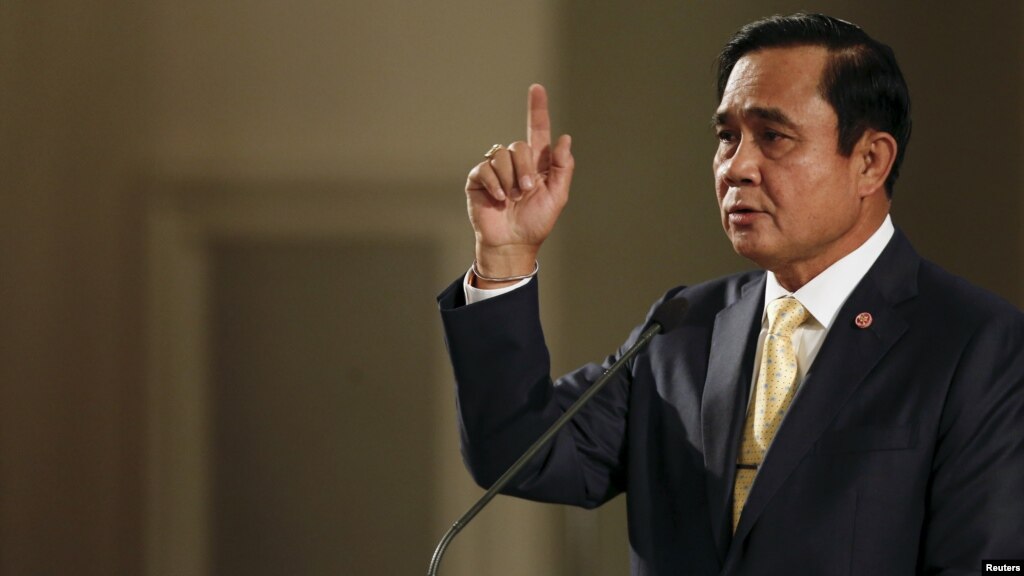
Röster om förslaget på ny militär konstitution.

gäst
3 mars 2016#1

Hej

Så här beskriver The Diplomat konstitutionen, dess odemokratiska delar och spelet runt den http://thediplomat.com/2016/02/the-trouble-with-thailands-new-constitution/

The Trouble with Thailand’s New Constitution

The new document contains undemocratic provisions that will do little to resolve the country’s protracted political crisis.

By Rob Edens for The Diplomat
February 26, 2016
 While attending a summit hosted by Barack Obama in southern California last week, Thailand’s former army chief and current Prime Minister Prayuth Chan-o-cha reassured the American president that his country was still on the path to organizing fresh elections and restoring democracy—nearly two years since Prayuth’s own coup d’état brought down Thailand’s last democratically-elected leader.

Since overthrowing Yingluck Shinawatra’s government in May 2014, the ruling National Council for Peace and Order (NCPO) has repeatedly pushed back promised elections; polls that were originally slated for mid-2015 are now expected in 2017 (or even 2018).

Much of this delay has stemmed from the project to ratify a new constitution, particularly since the military-appointed National Reform Council (NRC) already rejected one exceedingly controversial draft last September. Possibly in response to accusations that a cyclical process (of presenting intentionally unacceptable drafts for rejection) would allow the NCPO to remain in power indefinitely, now-Prime Minister Prayuth insists 2017’s elections will go forward with or without a constitution.

Even though last year’s proposed constitution failed to make it past the NRC, a new draft – released on January 29th - still contains anti-democratic fail-safes (from the military’s perspective) and will still allow the NCPO to exercise unchecked control over the interim government and election process all the way through the formation of a new cabinet.

Last year’s draft document, for its part, was rebuffed in the face of withering criticism from both sides of the political divide. Among other stipulations, it would have allowed a panel of military and police officials to wrest political authority from the civilian parliament. The potential constitution now before the NRC’s successor body (the National Reform Steering Assembly, or NRSA) draws instead on Thailand’s currently disbanded Senate as a vehicle for inserting military prerogatives into the structures of the civilian state.

If the proposed constitution is adopted, the reconstituted Senate will comprise 200 appointed (i.e. unelected members) and will lack any stipulations for equal representation between the most important professions. With nothing preventing a Senate dominated by the army and the security services, the junta will have a free hand in creating a reliable voting bloc. A Senate with this slant would be capable of blocking legislation and hamstringing the executive branch. Furthermore, the draft allows for individuals outside of parliament (for example, Prayuth Chan-o-cha) to serve as Prime Minister.

As for the new document, both the Pheu Thai party—aligned with Yingluck and her brother (and fellow former premier) Thaksin Shinawatra—and its chief rival, Abhisit Vejjajiva’s Democrat Party, have come out against the undemocratic provisions, seemingly designed to prevent either one from instituting stable or effective civilian governance.

Pheu Thai accuses the constitutional project of aiming to “bonsai” the party by preventing it from securing a parliamentary majority or, failing that, to undermine the strength of an eventual Pheu Thai government (if not overthrow it outright through the Constitutional Court). Abhisit, for his part, took to his official Facebook page to call for the direct election of senators, protections for both community and individual rights, an election system other than the single-ballot voting currently specified by the draft, and specific stipulations for when and how an individual not serving in parliament could be selected as Prime Minister. As he put it: “The door shouldn’t be open permanently for persons who do not represent Thai people to head the executive branch.”

In a demonstration of just how stringently Thailand’s body politic opposes the new draft, even former premier Thaksin Shinawatra (currently in exile) broke his extended radio silence to speak out against it and urge the junta toward reconciliation. In an interview with the Financial Times from Singapore, Thaksin urged Prayuth and the NCPO to scrap the draft (which was, in his view, “crazy”) and instead called for dialogue with the public to avoid a protracted military dictatorship. The junta, however, was unreceptive to the former premier’s overtures and dismissed the former leader as a “fugitive.”

Of course, Pheu Thai and the Shinawatra family are most directly targeted by the military junta’s machinations and have the most to lose (at least in the short term) if the current constitutional draft is adopted. That being said, the complaints from both leading parties about the document’s illiberal and undemocratic elements—and the loopholes those provisions create—are easily justifiable based on the contents of the draft. Even Meechai Ruchupan, who heads the Constitutional Drafting Committee, referred to the document now before the National Reform Steering Assembly (NRSA) as “strong medicine” that was not necessarily designed to earn the buy-in of the political parties. Echoing previous comments from the junta leadership, Meechai and his drafting committee seem to see the country’s political parties—and, by extension, the public’s elected representatives—as a nuisance to be curtailed rather than the building blocks of a stable democratic order.

In those same remarks, Meechai admitted that the current draft would not necessarily prove lasting if adopted, despite being Thailand’s 20th constitution in 84 years. If it fails, not even its architect knows what the next steps would be. While Prayuth and the NCPO would prefer to drag out the interim process (to prevent a likely Pheu Thai victory in any election), growing domestic and international pressure is making it more difficult to sustain the current state of “emergency” rule—a period has led directly to the deterioration of Thailand’s relationship with Washington and other Western allies as well as falling exports and evermore draconian enforcement of Bangkok’s (in)famous lèse-majesté laws.

Rob Edens is a London-based researcher.


Med vänlig hälsning isan lover

gäst
3 mars 2016#2

Hej

Här spekulerar The Diplomat om att ett eventuellt kommande val kan bli betydelselöst eftersom Juntan ändå behåller makten via sitt förslag till konstitution och det faktum att senaten ska utses och inte längre väljas som tidigare.

http://thediplomat.com/2016/03/why-thailands-next-election-may-not-matter/

Why Thailand’s Next Election May Not Matter

There are already signs that upcoming polls may be little more than a faux election.

7XRzjYON
By Prashanth Parameswaran for The Diplomat
March 01, 2016
 

Since Thailand experienced a military coup last May, international observers have been anxiously waiting to see when the ruling junta will allow an elusive election to take place to restore democratic governance. Yet with the Thai military once again bent on tinkering with the rules of the game to produce a political outcome favorable to its interests, one can be forgiven for wondering if the holding of the election itself may even matter.

The latest indications from the junta are that the election, first promised for late 2015, will be held around mid-2017. The “6-4-6-4” road map to democracy revealed in September last year posits six months to draft a new constitution, four months to hold a referendum on it, six months to draft organic laws to support the constitution and four months to campaign ahead of the election. The unveiling of a new version of the constitution earlier this month suggests that we are still on track for this timetable, at least for now.

But the crux of the problem in Thailand has not been the holding of the election itself, but the unwillingness of various groups to accept the outcome. Political contestation in Thailand over the past decade has occurred against the backdrop of a struggle between the military-backed royalist elite and parties linked to policeman-turned-business tycoon Thaksin Shinawatra. While Thaksin-linked parties have won each of the country’s last three elections – in 2001, 2007 and 2011 – each time they have been by ousted by military coups, paralyzing political protests, and other legal maneuvers. With the latest coup in May 2014 deposing Thaksin’s sister Yingluck, Thailand continues to try to find what renowned Thai commentator Thitinan Pongsudhirak describes as a balance between competing sources of elected and unelected political legitimacy.

As part of this process, the ruling junta and affiliated groups are now once again tinkering with the rules of the game to both prevent Thaksin-linked parties from winning in the country’s next election as well as to retain enough power to intervene again at a future date, particularly with a royal succession pending. The health of revered monarch Bhumipol Adulyadej has been deteriorating. The latest draft of the proposed constitution is a case in point. If it is adopted, Thailand’s Senate would be appointed rather than elected, while individuals outside of parliament (such as junta chief Prayut Chan-o-cha) will be eligible to be appointed prime minister. This is in line with previous attempts to change the rules of politics by boosting the military’s political role, weakening the power of the parliament and executive, and manipulating legal bodies.

But the current draft of the constitution also calls for a change in the way that Thais elect their representatives, which could have a significant impact on electoral outcomes. Specifically, indications are that the switch to a version of a mixed member system called the mixed member apportionment system (MMA) could lead to greater vote shares for medium-sized parties in upcoming polls, creating the conditions for the formation of a coalition of those parties and the Democrat Party against the Thaksin-linked party.

While it is impossible to definitively prove how polls will turn out until they occur, there is enough reason to suggest that this might be the case. While the electoral system Thailand used in 2011 (mixed member majoritarian, or MMM) and the proposed MMA for upcoming elections in 2017 are both mixed member, proportional representation systems, the new MMA is more proportional than MMM. In general, greater proportionality tends to benefit smaller parties at the expense of more dominant ones, with the devil being in the details, including threshold levels as well as how exactly the party list system is implemented.

For a more concrete sense of the outcome, consider the results of a recent simulation run by Allen Hicken, a professor at the University of Michigan and a noted Thai expert. Hicken’s simulation looks at how the 2011 election results might map onto the 2017 elections under the MMA system, using the new rules which, as stipulated under the constitution, would apply to 350 constituency seats and 150 party list seats. As is the case in mixed member systems, voters would essentially cast two votes – one for a constituency representative and one for a party – except they would do so in a single, fused ballot as opposed to two separate ones.

Upon running the simulation, Hicken found that the pro-Thaksin Pheu Thai party would get a diminished share of seats this time relative to the 2011 elections as the ruling junta would want, going from 265 seats (53 percent) to 225 seats (45 percent). But the simulation also found that the other major party, the Democrat Party, would only gain a single seat, going from 159 seats (31.8 percent) to 160 seats (32 percent). Indeed, the bulk of the seats that Pheu Thai lost in the simulation went to medium-sized parties.

What does all of this mean? Well, if this is indeed what happens after the elections, the military and other affiliated groups may try to bring together the Democrats and other medium-sized parties in some sort of coalition government to prevent, or at least blunt, the Thaksin-linked Pheu Thai’s return to power despite it being the largest party. Furthermore, if a “crisis” of some kind is deemed to have occurred, we could even have this unity government led by a military or military-backed individual, since the newly proposed constitution has a provision allowing for an unelected prime minister.

We’ve seen this playbook before following the 2007 elections. In those polls, the Thaksin-linked People’s Power Party (PPP) won the largest share of the vote and formed a six-party coalition government, leaving the Democrat Party headed by Abhisit Vejjajiva in opposition. But by 2008, after extended street protests, the banning of the PPP and two of its coalition allies by the constitutional court, and some alleged arm-twisting by the military, members of parliament (MPs) from former PPP-coalition parties crossed the aisle to endorse a Democrat-led coalition government.

“[T]his was a mechanism that was…in fact engineered by the very same people who staged the coup. So they know exactly how to do it,” Duncan McCargo, one of the world’s leading experts on Thai politics, warned in a talk at the Brookings Institution last week.

This scenario is far from ideal. Cobbling together a coalition government to blunt a democratic outcome that the military does not want is hardly a sustainable way to resolve a protracted political struggle. In the post-2007 election case, the formation of a Democrat-led coalition government only angered the pro-Thaksin Red Shirts, which resulted in violent protests, a state of emergency, and ultimately a general election in 2011 which the Democrat Party lost to Pheu Thai led by Thaksin’s sister Yingluck. For all his faults, Thaksin’s popularity is rooted in broader societal changes in Thailand which account for his strong support in the north and the northeast. Attempts to paper over a political divide rooted in structural societal changes with engineered elite deals are likely to fail.

Beyond the outcome itself, the process could also prove more difficult than it has been in the past. Thais as well as international observers may be less likely to accept essentially a repeat of a scenario they have seen before. And with the military directly in charge of the country this time, this scenario might be relatively tougher to sell in a polarized political climate. Arm-twisting parties and individual MPs may also harder to accomplish – as one Thai expert put it, “it may be difficult to find scapegoats because they may be afraid of being crucified.”

All this also assumes that the junta actually plans on holding polls at all and that they intend to return Thailand to a form of ‘civilian-led rule’ for various reasons, including the buildup of Western and domestic pressure. But as Shawn Crispin wrote recently for The Diplomat, that’s not necessarily the case. Crispin argues that the junta is unlikely to hold a faux election as of now because the risk is too high that a pro-Thaksin government will be swept into power, thereby reversing the junta’s policies and potentially even taking political revenge. In addition, he suggests that the “democratic lesson” of the 2007 elections would act as a further deterrent to the junta holding polls, especially with the royal succession still unresolved and no clear sign yet that the urban-based middle class will resist continued military rule. Instead, Crispin says the most likely scenario is that Prayut remains in charge until what he terms “the actuarial moment.”

But if indeed the junta decides to hold the election as it has claimed, as of now the aforementioned outcome looks like the best one it can hope for.

“It’s not straightforward, it’s very messy and unsatisfactory, but it’s…the best unsatisfactory outcome that the military could hope for, with all the different things that they are juggling around here,” McCargo said.


Med vänlig hälsning isan lover

gäst
19 mars 2016#3

Hej


Voice of America är starkt kritiska till juntans förslag till ny Militär Konstitution som dom anser underminerar demokratin, försvagar politikernas inflytande samt fråntar en vald regering makten.


http://www.voanews.com/content/thai-government-commission-clash-over-drafting-new-constitution/3241542.html

Thai Government, Commission Clash Over Drafting New Constitution
March 17, 2016 4:59 AM

FILE - Thailand's Prime Minister Prayuth Chan-ocha addresses the nation and summarises the junta government's annual report in Bangkok, Thailand.
 
Bangkok—

Thailand’s military government and constitutional drafting commission are in a stand-off after the Cabinet called for a new charter to include a non-elected senate and an appointed prime minister over transitional five year period. The government’s proposals have triggered sharp reactions from major political parties amid warnings of potential conflict if the proposals are included in the new constitution.

The commission’s draft allows for the election of a 500 member House of Representatives. A 200 member senate would be elected by interest groups and organizations.

But the government’s proposals call for a 250 member appointed Senate, including reserved seats for the permanent secretary of defense, supreme commander, and commanders of army, navy and air force and the chief of police.

Thai Deputy Prime Minister Prawit Wongsuwon said the military’s proposal was aimed at preventing a coup, not to move against the elected House of Representatives. But analysts and politicians from Thailand’s major parties have been critical, saying such moves will weaken political parties and undermine democracy.

FILE - Thai Deputy Prime Minister and Defense Minister Prawit Wongsuwan.


Siripan Nogsuan Sawasdee, a political scientist at Chulalongkorn University, speaking at a seminar on constitutional reform, said such proposals will undermine the elected government.


Med vänlig hälsning isan lover

gäst
26 mars 2016#5

Hej

Även FN har synpunkter på Juntans förslag till ny militär konstitution, bl.a vill FN inte ha någon amnesti för NCPO (juntan), FN listade 10 förslag till Constitution Drafting Committee (CDC).

http://prachatai.org/english/node/5971

UN says new charter should not provide impunity for NCPO

Submitted by editor2 on Fri, 25/03/2016 - 14:00

UN’s human rights office has stated that people must be able to participate in the drafting process of the new constitution and that the new constitution should not provide impunity for the military government.

BBC Thai reported on Friday, 25 March 2016, that the UN’s Office of the High Commissioner for Human Rights (OHCHR) for Southeast Asia sent a letter to the junta-appointed Constitution Drafting Committee (CDC).

In the letter, the OHCHR listed 10 suggestions to the CDC, which is currently in the final review stage of the draft constitution.

The OHCHR suggested that the CDC should remove Article 257 of the draft constitution, which ensures that the authorities shall not be held responsible for the use of Section 44 of the Interim Charter, the section which gives the National Council for Peace and Order (NCPO) absolute power to maintain national security.

“The draft constitution should not exclude accountability for serious human rights violations that have resulted from the implementation of Article 44 of the 2014 Interim Constitution,” reads part of the letter.

Moreover, the OHCHR recommended that people must be able to participate in the drafting process and also in the process to pass the 2016 draft constitution.

The UN human rights agency added that the content of the constitution must be consistent with the international covenants on human rights to which Thailand is a party, such as the Universal Declaration of Human Rights and the International Covenant on Civil and Political Rights (ICCPR).

“The State has to ensure that human rights, particularly freedoms of expression, peaceful assembly and association, are fully respected and protected,” reads part of the UN’s suggestions.


Med vänlig hälsning isan lover

gäst
28 mars 2016#6

Hej

Den kommande s.k folkomröstningen om den nya militära konstitutionen liknar allt mer en fars, senaste utspelet ifrån juntans sida är enligt Bangkok Post att landets Armechef Theerachai Nakvanich har beordrat omedelbara tillslag mot dom personer eller grupper som kan tänkas framföra kritik mot förslaget innan omröstningen i Augusti.

Låter inte direkt som att det är tänkt att bli en folkomröstning liknande den som Demokratiska länder har utan mer en sådan som ledarna i forna Sovjet Unionen och nutida Nord Korea skulle ha regisserat.


Army boss orders crackdown on 'confusing' dissent Aims to contain order before constitutional referendum

28 Mar 2016 at 18:26
Army chief Theerachai Nakvanich on Monday ordered immediate crackdown on any action the government believes will lead people to “misunderstand" the government's workings before the charter referendum in in August.

Gen Theerachai, the NCPO's secretary-general, told subordinates the country has entered an important period where public participation in the referendum on the proposed constitution was essential according to Col Sirichan Ngathong, the junta's deputy spokesman.

"If any group creates misunderstanding or confuses society, officials will take immediate action to restore order," she quoted Gen Theerachai as saying.

The NCPO's peacekeeping force was working to educate the people on what the government is doing to ensure public participation and national order, Col Sirichan added.

http://www.bangkokpost.com/news/politics/913064/army-boss-orders-crackdown-on-confusing-dissent


Med vänlig hälsning isan lover


SatanG
Skattesmitare
30 mars 2016#7
On 2016-03-28 at 01:51, skrev Isan Lover:

Hej

Den kommande s.k folkomröstningen om den nya militära konstitutionen liknar allt mer en fars, senaste utspelet ifrån juntans sida är enligt Bangkok Post att landets Armechef Theerachai Nakvanich har beordrat omedelbara tillslag mot dom personer eller grupper som kan tänkas framföra kritik mot förslaget innan omröstningen i Augusti.

Låter inte direkt som att det är tänkt att bli en folkomröstning liknande den som Demokratiska länder har utan mer en sådan som ledarna i forna Sovjet Unionen och nutida Nord Korea skulle ha regisserat.


Army boss orders crackdown on 'confusing' dissent Aims to contain order before constitutional referendum

28 Mar 2016 at 18:26
Army chief Theerachai Nakvanich on Monday ordered immediate crackdown on any action the government believes will lead people to “misunderstand" the government's workings before the charter referendum in in August.

Gen Theerachai, the NCPO's secretary-general, told subordinates the country has entered an important period where public participation in the referendum on the proposed constitution was essential according to Col Sirichan Ngathong, the junta's deputy spokesman.

"If any group creates misunderstanding or confuses society, officials will take immediate action to restore order," she quoted Gen Theerachai as saying.

The NCPO's peacekeeping force was working to educate the people on what the government is doing to ensure public participation and national order, Col Sirichan added.

http://www.bangkokpost.com/news/politics/913064/army-boss-orders-crackdown-on-confusing-dissent


Med vänlig hälsning isan lover


Var utläser du det fetmarkerade i första stycket?


Att det finns grupper, bl.a. finansierade från kriminella i Dubai, som gör allt för att slå splittring i landet har nog alla förstått. Att dessa inte tillåts ljuga och sprida falsk information inför en viktig folkomröstning borde självklart vara bra för alla.


/ SatanG

gäst
30 mars 2016#8
5 timmar sedan, skrev SatanG:


Var utläser du det fetmarkerade i första stycket?


Att det finns grupper, bl.a. finansierade från kriminella i Dubai, som gör allt för att slå splittring i landet har nog alla förstått. Att dessa inte tillåts ljuga och sprida falsk information inför en viktig folkomröstning borde självklart vara bra för alla.


/ SatanG

Hej

Jag tycker att landets Armechef formulerar detta på ett tydligt sätt i denna mening " Army chief Theerachai Nakvanich on Monday ordered immediate crackdown on any action the government believes will lead people to “misunderstand" the government's workings before the charter referendum in in August. "

Att Juntan avser att det är kritiker till den föreslagna konstitutionen som ska drabbas av dessa omedelbara tillslag och inte positiva personer och grupper behöver man nog inte vara Einstein för att räkna ut.

Med vänlig hälsning isan lover

SatanG
Skattesmitare
30 mars 2016#9
35 minuter sedan, skrev Isan Lover:

Hej

Jag tycker att landets Armechef formulerar detta på ett tydligt sätt i denna mening " Army chief Theerachai Nakvanich on Monday ordered immediate crackdown on any action the government believes will lead people to “misunderstand" the government's workings before the charter referendum in in August. "

Att Juntan avser att det är kritiker till den föreslagna konstitutionen som ska drabbas av dessa omedelbara tillslag och inte positiva personer och grupper behöver man nog inte vara Einstein för att räkna ut.

Med vänlig hälsning isan lover


Ja jag förstår att du tycker det är tydligt då det passar bra in på vad du vill att det ska stå.

MEN det gör faktiskt inte det, denna gången heller! Men det är som vanligt, du klistrar på folk uppfattningar de aldrig uppgett sig ha då det passar bättre in i din värld.


Eller du kanske anser att bara för någon är kritisk mot juntan så har denne rätt att ljuga och sprida desinformation enbart för att gynna sig själv, på bekostnad av folket/landet? 


/ SatanG

gäst
30 mars 2016#10
9 minuter sedan, skrev SatanG:


Ja jag förstår att du tycker det är tydligt då det passar bra in på vad du vill att det ska stå.

MEN det gör faktiskt inte det, denna gången heller! Men det är som vanligt, du klistrar på folk uppfattningar de aldrig uppgett sig ha då det passar bättre in i din värld.


Eller du kanske anser att bara för någon är kritisk mot juntan så har denne rätt att ljuga och sprida desinformation enbart för att gynna sig själv, på bekostnad av folket/landet?


/ SatanG

Hej

Hur översätter du då "immediate crackdown" och den övriga texten ?

Och vad tror du avsikten med uttalandet är om du tycker att jag har fel i min tolkning av den ?

Med vänlig hälsning isan lover

gäst
30 mars 2016#11

Hej


I dagens Bangkok Post kan man läsa att Pheua Thai uppmanar folk att rösta nej till juntans nya militära konstitution i folkomröstningen, eftersom den anses vara odemokratisk.


Pheu Thai calls for people to reject draft charter

30 Mar 2016 at 12:55

The Pheu Thai Party has issued a statement calling for the people to reject the new draft constitution on the grounds it is undemocratic and contains many provisions likely to cause more problems for the country.


http://www.bangkokpost.com/news/politics/915649/pheu-thai-calls-for-people-to-reject-draft-charter


Med vänlig hälsning isan lover

SatanG
Skattesmitare
30 mars 2016#12
55 minuter sedan, skrev Isan Lover:

Hej

Hur översätter du då "immediate crackdown" och den övriga texten ?

Och vad tror du avsikten med uttalandet är om du tycker att jag har fel i min tolkning av den ?

Med vänlig hälsning isan lover


Det centrala i meningen är inte vad de ska göra utan varför.

" any action the government believes will lead people to “misunderstand" 

Alltså aktioner som missleder/förvirrar/sprider desinformation/ljuger i syfte att så splittring bland befolkningen och dess grupperingar tolkar jag artikelns mening till. 


/ SatanG

Tallviking
Veteran
30 mars 2016#13
58 minuter sedan, skrev Isan Lover:

Hej


I dagens Bangkok Post kan man läsa att Pheua Thai uppmanar folk att rösta nej till juntans nya militära konstitution i folkomröstningen, eftersom den anses vara odemokratisk.


Pheu Thai calls for people to reject draft charter

30 Mar 2016 at 12:55

The Pheu Thai Party has issued a statement calling for the people to reject the new draft constitution on the grounds it is undemocratic and contains many provisions likely to cause more problems for the country.


http://www.bangkokpost.com/news/politics/915649/pheu-thai-calls-for-people-to-reject-draft-charter


Med vänlig hälsning isan lover


Dom skall nog inte kasta sten när dom själva sitter i glashus


PT har ju inte direkt visat de demokratiska framfötterna ännu under sin tid vid makten


Under den korta Yinluck-eran lyckades man skapa ekonomiskt kaos och drev landet till randen av inbördeskrig !

gäst
30 mars 2016#14
13 minuter sedan, skrev SatanG:


Det centrala i meningen är inte vad de ska göra utan varför.

" any action the government believes will lead people to “misunderstand" 

Alltså aktioner som missleder/förvirrar/sprider desinformation/ljuger i syfte att så splittring bland befolkningen och dess grupperingar tolkar jag artikelns mening till.


/ SatanG

Hej


Du vet väl att Juntan nyligen gick ut med att Artikel 62 skulle tillämpas vilket innebär att "någon som publicerar text, bilder eller ljud, antingen genom tidningar, radio, TV, är elektroniska medier eller andra kanaler som antingen anses vara osann, hårda, offensiv, ohyfsad, anstiftar eller hotar med avsikt att påverka väljarna att inte utöva sin rösträtt eller för att påverka väljarna att rösta på ett visst sätt kommer att betraktas som en person som skapar förvirring att omröstningen inte kommer att gå vidare på rätt sätt. "straffet är fängelse på upp till 10 år och böter på upp till 200.000 baht.


Här finns det ju uttryckligen på pränt att det inte alls behöver handla om att någon "missleder/förvirrar/sprider desinformation/ljuger".

Det räcker enligt Juntans egna uppgifter med att någon person, grupp, tidningar, radio, TV, är elektroniska medier eller andra kanaler försöker påverka folk att inte rösta eller att rösta nej.


Kallar du all information, kritik eller uppmaningar som andra än Juntan och EC tillhandahåller för falsk och osann?


Är det inte näst intill medias huvuduppgift att bevaka, genomlysa och kritiskt granska politiska förslag?


Med vänlig hälsning isan lover

gäst
30 mars 2016#15
22 minuter sedan, skrev Tallviking:


Dom skall nog inte kasta sten när dom själva sitter i glashus


PT har ju inte direkt visat de demokratiska framfötterna ännu under sin tid vid makten


Under den korta Yinluck-eran lyckades man skapa ekonomiskt kaos och drev landet till randen av inbördeskrig !

Hej

Demokraterna var ju först ut och kritiserade förslaget och omröstningen och Pheua Thai gör helt rätt som följer deras exempel.

Med vänlig hälsning isan lover

Logga in för att svara.