Alice i Juntaland och envälde i Thailand!

gäst
4 maj 2016#256
2 minuter sedan, skrev Tallviking:


Det är märkligt vad många länkar om regeringskritiska uttalanden du hittar från de thailändska stora medierna ! :whistle:


Hej

Tänk då vad många och hårda dom skulle ha varit mot juntan och diktaturen om pressen hade varit fri.

Med vänlig hälsning isan lover

gäst
6 maj 2016#257

Hej

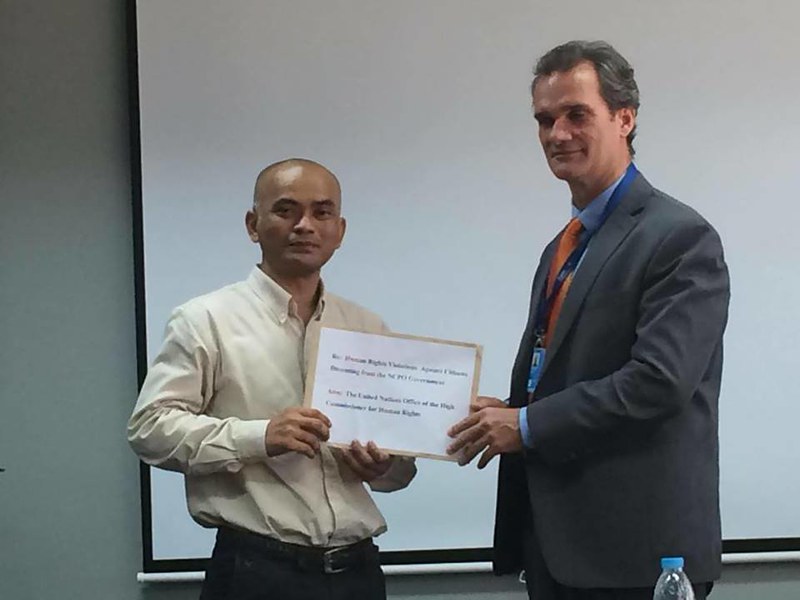
En grupp Thailändska Akademiker ber FN undersöka det ökande antalet människorätts brott som nu begås av juntan mot oppositionella inför folkomröstningen, Akademikerna överlämnade ett brev med kravet till FN,s Laurent Meillan som är chef på "UN’s Human Rights Office for South-East Asia (OHCHR)".


http://prachatai.org/english/node/6124?utm_source=feedburner&utm_medium=feed&utm_campaign=Feed%3A+prachataienglish+%28Prachatai+in+English%29

Academics urge UN to investigate rights violations under junta

Submitted by editor2 on Thu, 05/05/2016 - 14:11

Thai academics have urged the UN to investigate human rights abuses as the Thai junta increases its crackdown on political dissidents ahead of the referendum on the draft constitution.

The BBC Thai reported that 12 academics from leading universities in Thailand on Thursday, 5 May 2016, submitted a letter to the UN, urging the UN human rights office to investigate the increasing violations and abuses of human rights done by the Thai authorities.

The letter was submitted to Laurent Meillan, officer in charge of the UN’s Human Rights Office for South-East Asia (OHCHR).

In the letter, the group states that the National Council for Peace and Order (NCPO), the formal name of the Thai junta, has increasingly invoked its authorities under Section 44 of the Interim Charter and the NCPO’s orders No. 3/2015 or No. 13/2016 to arrest and prosecute political dissidents.

The academics pointed out to the recent case of the eight abducted junta critics who are charged with the Sedition Law and the Computer Crime Act as an example of the increasing political repression under the military regime.

Anusorn Unno, the dean of the Sociology and Anthropology Faculty of Thammasat University said that he hopes that the UN regional office will bring the case to the UN’s human rights office in Geneva, Switzerland, to come up with certain measures to pressure the Thai government.

“The issue that [we] want to bring to the government is the demand on the rights to freedom of expression of the people,” the BBC Thai quoted Anusorn as saying. “The measures [of the authorities] nowadays prevent people from expressing different opinions.”

Other academics of the group are Bencharat Sae-chua and Sriprapha Petcharamesree from Mahidol University, Aphichat Satitniramai and Pichit Likitkijsomboon from Thammasat University, Naruemon Tabjumphon and Prapas Pintoptang from Chulalongkorn University and Komkrit Uitekkeng from Silpakorn University.

26733458432_37fc8b44b7_c.jpg

Anusorn hands the letter to the group to Laurent Meillan, officer in charge of the UN’s Human Rights Office for South-East Asia (OHCHR) on 5 May 2016 (courtesy of the BBC Thai)


Med vänlig hälsning isan lover

möljis
6 maj 2016#258
On ‎2016‎-‎05‎-‎04 at 12:12, skrev Tallviking:


Det är märkligt vad många länkar om regeringskritiska uttalanden du hittar från de thailändska stora medierna ! :whistle:


Jag tror att IL knappt har tid att varken äta eller fiska hummer.....

gäst
7 maj 2016#259

Hej

Så här beskriver Chicago Tribune situationen i Thailand efter kuppen 2014.


http://www.chicagotribune.com/news/opinion/editorials/ct-Thailand-constitution-military-korea-taiwan-indonesia-edit-0509-md-20160506-story.html

Military repression halts progress: So much for paradise in Thailand

Eight people arrested after posting messages that criticize the military government on Facebook
Narong Sangnak, EPA

Police escort two unidentified Thai citizens who allegedly violated the Computer Crimes Act into military court in Bangkok, Thailand, on April 29, 2016. Eight people were arrested for allegedly posting messages critical of the military onto Facebook. If convicted, the alleged offenders could face up to 10 years in prison.

Police escort two unidentified Thai citizens who allegedly violated the Computer Crimes Act into military court in Bangkok, Thailand, on April 29, 2016. Eight people were arrested for allegedly posting messages critical of the military onto Facebook. If convicted, the alleged offenders could face up to 10 years in prison.

(Narong Sangnak, EPA)

Thailand is an exotic destination for travelers and a big Southeast Asian economy, but it has an ugly side. Freedoms there are under siege from a heavy-handed military government that intends to rule indefinitely.

While Thailand has a shaky political history, the country ramped up its commitment to free markets and free elections in the 1990s, a development that was good for the country and the rise of democracy in Asia. For a while you could put Thailand in the same basket as South Korea, Taiwan and Indonesia — each a positive example of how economic liberalization can lead to political liberalization.


These days Thailand is defying that model. The Thai military seized power in 2014 for the second time in a decade, damaging the country's chances of securing a stable, representative government. Rather than rebooting and trying again for democracy, Thailand's army seems determined to keep order by keeping power.

This is a mistake with far-reaching consequences. The instability is messing up Thailand's export-driven economy because investors are leery of putting money in a country that looks untrustworthy. For U.S. interests there is a larger concern: whether undemocratic Thailand might drift into China's orbit. Certainly the Thai military government today has more in common with Beijing than Washington.


Med vänlig hälsning isan lover

Wanchai
Wanchai
7 maj 2016#260
On 2016-05-06 at 08:36, skrev möljis:

Jag tror att IL knappt har tid att varken äta eller fiska hummer.....


Jag tror att han ingår i något kommunistiskt nätverk som har jour 24 timmar om dygnet och de skickar länkar och förslag på text till IL som han kan lägga in när han vaknat eller kommit hem efter hummerfisket. Det är därför det många gånger inte anknyter till det aktuella i tråden eller uppfattas som lögn och fantasi.


Nu spekulerar jag men det är kanske så det går till.......

gäst
9 maj 2016#261

Hej


Asian Correspondent har en artikel med titeln "Den oroande sanningen bakom den thailändska juntans mediekampanj" där man tar upp juntans misslyckade försök att framstå i bättre dager hos EU och USA som uttrycker oro över utvecklingen i Thailand med juntan vid makten, nu bemöter juntan denna oro med ännu en PR-kampanj genom att skicka ut ett sex sidors dokument till diplomat anställd personal jorde runt, men Asian Correspondent sågar juntans försök till ett bättre anseende via denna PR-kampanj jämns med fotknölarna.


https://asiancorrespondent.com/2016/05/unsettling-truth-behind-thai-juntas-media-campaign/


The unsettling truth behind the Thai junta’s media campaign

by Alistair Denness | 5th May 2016


Thailand's Prime Minister Prayuth Chan-ocha. Pic: AP.
facebook-f.pngshare-twitter.pngshare-pinterest.png

Thailand's Prime Minister Prayuth Chan-ocha. Pic: AP.

 
HAVING failed to convince the international community of its benevolent intentions, junta leaders in Thailand last week issued a six page PR document to diplomatic staff around the globe in an attempt to reverse opinion and salvage the last vestiges of the country’s battered reputation. The document comes after the European Union froze talks over a planned Free Trade Agreement and threatened to slap the Thai fishing industry with sanctions over its use of slave labor.

Recently, in a rare show of European unity, the 28 EU Ambassadors expressed their concern over “alarming developments” in the regime’s increasingly aggressive attitude adjustment programs and its continuing stifling of basic freedoms. Across the Pacific, even Thailand’s historical ally, the United States, has been taking a harder line against the Bangkok junta and has been scaling down its military cooperation with the Royal Thai Armed Forces.


Med vänlig hälsning isan lover


gäst
10 maj 2016#262

Hej

En bra artikel i New Mandala som tar upp läget i diktaturens Thailand och dom problem juntan står inför som den kommande folkomröstningen, minskad popularitet, utebliven försoning och att juntan tänker behålla en viss makt till 2022.


http://asiapacific.anu.edu.au/newmandala/2016/05/10/thai-junta-to-get-its-report-card/?utm_source=feedburner&utm_medium=feed&utm_campaign=Feed%3A+edu%2FbWcZ+%28New+Mandala%29  


Thai junta to get its report card

– 10 May 2016Posted in: Thailand
Photo: null0 on flickr

Photo: null0 on flickr

Many have promised to bring Thailand together, but only succeeded in uniting people against them. The increasingly-isolated Thai junta could soon get the measure of their own popularity, Paul Sanderson writes.

Uniting the country is so often the catch-cry of those who would do anything but. In Thailand, a succession of prime ministers both elected and not have pledged to bring the country together as more than a decade of bitter division has seethed and occasionally flared into violence.

Former Prime Minister Yingluck Shinawatra’s administration gave probably the most obvious example of this when their ill-advised attempt to introduce a bill at 3am giving a sweeping amnesty to the country’s greatest political troublemakers, including her fugitive brother, only succeeded in uniting the country against them. Many of those aligned ideologically with the ruling party, and even several government MPs, joined the chorus of condemnation.

History, as is its wont, is in danger of repeating itself. The military regime, known officially as the National Council for Peace and Order, will mark its second anniversary on May 22. It has held power almost as long as Yingluck had before the Pheu Thai party’s tactical blunder.

The junta is embarking on a referendum as it finds itself increasingly isolated: Fewer and fewer voices speak out in support of Prayut Chan-o-cha’s regime and the draft charter it almost dictated to chief constitution writer Meechai Ruchupan.

Even those who were anti-Yingluck in 2013 have condemned the NCPO’s transparent plan to cling on to power for a further five years after the slated 2017 election, should it go ahead. Former PM Abhisit Vejjajiva, who was on the streets for some of the Bangkok Shutdown protests, spoke out against the draft constitution, saying it “distorts” democracy and “weakens people’s power”.

The regime is not quite at the point of uniting the country against it, but the August 7 referendum and the crackdown on dissent will seriously test its support.

The Election Commission has expressed confidence of a turnout of 80 per cent, telling Reuters about 51 million people were eligible to cast a vote. This would be significantly higher than the 57 per cent who turned out for the comparable 2007 referendum on a military-led charter, although commissioner Somchai Srisuthiyakorn would not say why. (Somchai, it is worth noting, is a controversial figure himself.)

It would also be a higher turnout than most general elections of the past 20 years, which have hovered between 60 and 70 per cent – the outliers being the 2007 post-coup poll when 85 per cent went to the polls as the ousted Thaksin Shinawatra and his opponents rallied support, and the 2014 pre-coup ballot, when about 47 per cent  of eligible voters showed up amid protests, cancellations and after a shooting designed to scare people away.

The suggestion that 40 million people could vote on  August 7 may be based on optimistic interpretations of polling. A Suan Dusit poll in mid-April found 85 per cent of respondents thought the constitution was important to the country’s future. But they may as well have asked whether they thought the record-breaking summer was hot: of course it’s important.

A closer look at the results, from a polling agency that has produced headlines favourable to the regime, reveals two-thirds were not impressed by the draft constitution. Curiously, 73 per cent said they might have “other things to do” on the day of the election. More than half said politics served only vested interests and thought the referendum was a waste of money.

The Election Commission made another public foray at the end of April, issuing a list of dos and don’ts for those keen on campaigning. The don’ts are problematic, with activists and political figures questioning the vagueness of phrases such as “false information”, “incite the public politically” and “incites unrest”.

The commission’s guide came after the junta, more worryingly, declared that expressing too strong an opinion in the lead-up to the referendum could bring about a 10-year jail term. Other penalties include a potential 10-year ban from politics and hefty fines. There have already been arrests.

This being a country where smiles are shallow and cynicism runs deep, there is always another theory or three. One goes that the referendum is being set up to fail: Gen Prayut’s terse replies when pressed on what would happen in that event suggest there is a contingency plan they want to keep guarded. Another goes that the smattering of protests will be used to justify calling the referendum off altogether: the roadmap to elections has already been pushed out two years and the military sank its first draft, so there is precedent. Other speculation quickly turns into sad stories of the death of kings.

There is a mindset that the military wasted the 2006 coup and returned the country to democracy too quickly. No chances are being taken this time. This is not a new observation, but with the referendum coming into focus it is worth asking just how long the status quo will be tolerated.

Chulalongkorn University’s Thitinan Pongsudhirak raised all these points in April, with a forecast of long-term military rule and a road ahead that will “most likely be marked by more turmoil”.

The junta is determined to be around in some capacity until at least 2022. The referendum is not likely to alter its grand plans, but it will provide some indication of how much of the country is united behind them, and how much against.

Paul Sanderson is a pen name. The author is an independent writer and consultant based in and around Southeast Asia.


Med vänlig hälsning isan lover

Logga in för att svara.