H&M betalar 500:- i månadslön för 280 timmar?

svampen
24 okt. 2012#1

3:- i timmen? ???? ???? ???? ????

Cambodian-garment-workers-007.jpg

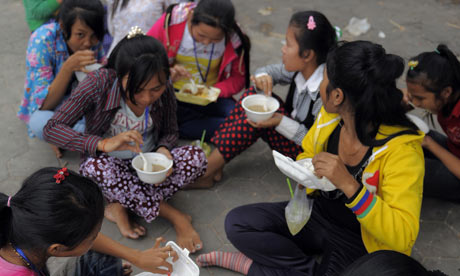
Garment workers eat in front of a clothes factory in Phnom Penh. The minimum wage in Cambodia is equivalent to £42 a month. Photograph: Tang Chhin Sothy/AFP/Getty

Workers in Cambodia will hold a "people's tribunal" next week to investigate pay and conditions at factories working for fashion brands including H&M and Gap.

An international panel of judges will hear evidence from workers, factories and multinational brands including Puma and Adidas. H&M said it would not attend but would supply information about how it was addressing wages at its suppliers' factories in the country.

The two-day hearing aims to raise awareness of low pay and long working hours that workers say are partly responsible for a series of "mass faintings" involving hundreds of workers at factories supplying H&M, Gap and sports brands.

Up to 300 workers will give evidence about the fainting incidents and about living conditions resulting from low wages.

The minimum wage in Cambodia is the equivalent of just $66 (£42) a month, a level that human rights groups say is almost half that required to meet basic needs.

Ath Thorn, president of the Cambodian Coalition for Apparel Workers Democratic Unions, said: "Because the workers get low wages they try to work 10 to 13 hours a day to get the money they need for their family."

He said workers needed a basic wage equivalent to at least $100 (£63) a month to get by without putting their health in danger. "Workers are fainting because of long working hours and the environment in the factory," he said.

Fumes from chemicals, poor ventilation, malnutrition and even "mass hysteria" have all been blamed for making workers ill.

A report by the International Labour Organisation said at least 11 garment factories experienced fainting incidents and more than 1,500 workers fainted or collapsed during working hours last year.

In August, nearly 300 workers passed out in one week at a Cambodian factory supplying H&M, prompting an investigation by the Swedish retailer. More than 100 people were reported to have been taken to hospital after the incidents at M&V International Manufacturing in Kampong Chhnang.

A report commissioned by H&M blamed the faintings on mass hysteria caused by work-related and personal stress.

About 100 workers fainted at the Huey Chen factory, which supplies Puma, in April last year and another 49 passed out at the same factory in July. Puma said it had implemented an improvement plan at the factory and commissioned a report into the reason for the faintings. It said it was working with the factory and local authorities to "take every precaution that compliance with our social and labour standards is ensured".

Jeroen Merk, of the workers' rights pressure group Clean Clothes Campaign, said it was "disappointing" that H&M and Gap had chosen not to attend the tribunal.

A spokeswoman for H&M said: "Workers should earn a fair wage and we strive for decent supply chain working conditions. To tackle this challenge we last year joined the Fair Wage Network to find out more about how we can contribute to more fair wages."

Adidas said its factory workers earned nearly twice as much as police officers or teachers in the same region and considerably more than the minimum wage. A spokesman said: "Workplace conditions at our major suppliers have been the subject of independent verification and certification and we constantly question and improve our performance."

The Clean Clothes Campaign and the British campaign group Labour Behind the Label supported local members of Asia Floor Wage, a coalition campaigning for higher minimum wages across the continent, in setting up the tribunal. They said the event was an attempt to raise awareness in a less confrontational way than strikes.

The move comes after 1,000 union leaders were dismissed after strikes for better pay and conditions involving 200,000 workers last year.

Clothing and footwear is a vital part of Cambodia's economy, employing more than 300,000 people, mostly women. Last year exports of garments and footwear rose by 25% from to $4.24 bn (£2.68bn), making up 85% of total exports.

3:-/timmen till Camboidas arbetare på HM:s fabriker Fy Fan har ej råd till mat hela månaden!!!!

Hoppas att alla som sett Uppdrag Granskning ikväll aldrig mer sätter sin fot i en HM-butik!

Fy Skäms HM!!!!!!!

Bojkotta,Bojkotta!!!!!!!!!!!!!!!!!!

Mvh Svampen

conservator
24 okt. 2012#2

Hur mycket vill vi konsumenter betala för en t-shirt ? ofta blir nog svaret så bra kvalitet för så lite pengar som möjligt men utan att tänka på hur det var möjligt!

HajKaj
nykter sedan i morse
24 okt. 2012#3

köper alla mina kläder på lokalprodukt marknaden. en t-shirt kostar runt 300 där.

conservator
24 okt. 2012#4

Nu har det ju tom. kommit ut kopior på HM kläder runt om i Bkk o säkert i andra delar med!

pigge01
Resenär
24 okt. 2012#5

Om klädbolagen skulle dubbla lönen på fabriken.

Så skulle detta inte påverka vinsten i bolaget

Kunderna betalar detta en femma mera per plagg.

Hälsar pigge01

HajKaj
nykter sedan i morse
24 okt. 2012#6

Om klädbolagen skulle dubbla lönen på fabriken.

Så skulle detta inte påverka vinsten i bolaget

Kunderna betalar detta en femma mera per plagg.

Hälsar pigge01

dessutom skulle man få en jäkla massa "gratis reklam" i tidningarna. För att man ser till att arbetarna skulle kunna leva på sina slavlöner.

nitramj77
25 okt. 2012#7

Jag läste någonstans att var 7e krona som spenderas i en HM butik går till aktieutdelning, så de är extremt lönsamma.

Soengsang
Avregistrerad
25 okt. 2012#8

Visst är det härligt med den solidariska kapitalismen som råder i vår värld!

Sent by my flintaphone and Tapatalk

audirs2
Styrelse medlem.
25 okt. 2012#9

Vinst 2011 15,miljarder!

Svin e dom helt enkelt dom där HM!

Soengsang
Avregistrerad
25 okt. 2012#10

Vinst 2011 15,miljarder!

Svin e dom helt enkelt dom där HM!

Varför.de gör ju bra vinst och det är ju det allt går ut på i en kapitalistisk värld ...grattis till dem!

acarls
25 okt. 2012#11

Vinst 2011 15,miljarder!

Svin e dom helt enkelt dom där HM!

Jo men det blir ju en del skatt på den vinsten.

gäst
25 okt. 2012#12

3:- i timmen? ???? ???? ???? ????

Cambodian-garment-workers-007.jpg

Garment workers eat in front of a clothes factory in Phnom Penh. The minimum wage in Cambodia is equivalent to £42 a month. Photograph: Tang Chhin Sothy/AFP/Getty

Workers in Cambodia will hold a "people's tribunal" next week to investigate pay and conditions at factories working for fashion brands including H&M and Gap.

An international panel of judges will hear evidence from workers, factories and multinational brands including Puma and Adidas. H&M said it would not attend but would supply information about how it was addressing wages at its suppliers' factories in the country.

The two-day hearing aims to raise awareness of low pay and long working hours that workers say are partly responsible for a series of "mass faintings" involving hundreds of workers at factories supplying H&M, Gap and sports brands.

Up to 300 workers will give evidence about the fainting incidents and about living conditions resulting from low wages.

The minimum wage in Cambodia is the equivalent of just $66 (£42) a month, a level that human rights groups say is almost half that required to meet basic needs.

Ath Thorn, president of the Cambodian Coalition for Apparel Workers Democratic Unions, said: "Because the workers get low wages they try to work 10 to 13 hours a day to get the money they need for their family."

He said workers needed a basic wage equivalent to at least $100 (£63) a month to get by without putting their health in danger. "Workers are fainting because of long working hours and the environment in the factory," he said.

Fumes from chemicals, poor ventilation, malnutrition and even "mass hysteria" have all been blamed for making workers ill.

A report by the International Labour Organisation said at least 11 garment factories experienced fainting incidents and more than 1,500 workers fainted or collapsed during working hours last year.

In August, nearly 300 workers passed out in one week at a Cambodian factory supplying H&M, prompting an investigation by the Swedish retailer. More than 100 people were reported to have been taken to hospital after the incidents at M&V International Manufacturing in Kampong Chhnang.

A report commissioned by H&M blamed the faintings on mass hysteria caused by work-related and personal stress.

About 100 workers fainted at the Huey Chen factory, which supplies Puma, in April last year and another 49 passed out at the same factory in July. Puma said it had implemented an improvement plan at the factory and commissioned a report into the reason for the faintings. It said it was working with the factory and local authorities to "take every precaution that compliance with our social and labour standards is ensured".

Jeroen Merk, of the workers' rights pressure group Clean Clothes Campaign, said it was "disappointing" that H&M and Gap had chosen not to attend the tribunal.

A spokeswoman for H&M said: "Workers should earn a fair wage and we strive for decent supply chain working conditions. To tackle this challenge we last year joined the Fair Wage Network to find out more about how we can contribute to more fair wages."

Adidas said its factory workers earned nearly twice as much as police officers or teachers in the same region and considerably more than the minimum wage. A spokesman said: "Workplace conditions at our major suppliers have been the subject of independent verification and certification and we constantly question and improve our performance."

The Clean Clothes Campaign and the British campaign group Labour Behind the Label supported local members of Asia Floor Wage, a coalition campaigning for higher minimum wages across the continent, in setting up the tribunal. They said the event was an attempt to raise awareness in a less confrontational way than strikes.

The move comes after 1,000 union leaders were dismissed after strikes for better pay and conditions involving 200,000 workers last year.

Clothing and footwear is a vital part of Cambodia's economy, employing more than 300,000 people, mostly women. Last year exports of garments and footwear rose by 25% from to $4.24 bn (£2.68bn), making up 85% of total exports.

3:-/timmen till Camboidas arbetare på HM:s fabriker Fy Fan har ej råd till mat hela månaden!!!!

Hoppas att alla som sett Uppdrag Granskning ikväll aldrig mer sätter sin fot i en HM-butik!

Fy Skäms HM!!!!!!!

Bojkotta,Bojkotta!!!!!!!!!!!!!!!!!!

Mvh Svampen

IKEA ar precis samma skrot,utat satt ar det valdigt praktigt,gar hem i folkhemmet,men tyvarr ar det inte hela sanningen,jag ar val insatt i sanningen!

Halsningar

Chan2011

Tallviking
Veteran
25 okt. 2012#13

Betalar H&M sämre lön till sina arbetare i Kambodja än vad andra företag betala sina arbetare i Kambodja ?

måne
måne
25 okt. 2012#14

Är det därför mina HM aktier har gått så bra genom åren.Är ju inte speciellt just att betala svältlöner när de genererar så stor avkastning,hoppas denna mediala rapport kan förbättra deras levnadsvillkor.Men det blir väl som i Thailand,cheferna får bättre lön.

gäst
25 okt. 2012#15

Betalar H&M sämre lön till sina arbetare i Kambodja än vad andra företag betala sina arbetare i Kambodja ?

Ja, det finns en del kedjor som har förbundigt sig till att betala så kallad levnadslön. Något som H&M har motsatt sig med hänvisning till att det inte finns branschpraxis. Nu är de inte ensamna om att exploatera fattiga men är man en stor aktör som gör stora vinster så bör man granskas ordentligt när det sker (enligt mitt tycke) på andras bekostnad.

Logga in för att svara.